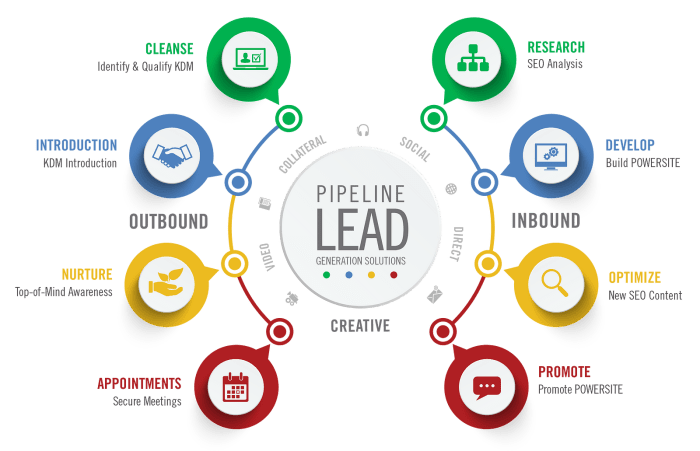
In today’s digital landscape, acquiring high-quality leads is paramount for business success. This exploration delves into effective lead generation strategies, examining how content marketing, , social media, email campaigns, and paid advertising synergistically contribute to a robust lead nurturing pipeline. We’ll navigate the complexities of optimizing landing pages, analyzing performance metrics, and ultimately converting leads into loyal customers.
Understanding the nuances of each digital marketing channel is crucial. From crafting compelling content that resonates with target audiences to leveraging the power of search engine optimization and paid advertising, we will uncover actionable insights to enhance your lead generation efforts. We will also explore the critical role of lead nurturing and the importance of consistent monitoring and optimization.
Defining Lead Generation in Digital Marketing

Lead generation in digital marketing is the process of attracting and capturing the contact information of potential customers who have shown interest in your product or service. These potential customers, known as leads, are then nurtured and converted into paying customers. It’s a crucial element of any successful digital marketing strategy, as it provides a pipeline of qualified prospects for sales teams to engage with.
The ultimate goal is to generate high-quality leads – individuals who are genuinely interested and likely to make a purchase.The core concept hinges on strategically using online channels to attract individuals who align with your ideal customer profile. This involves understanding your target audience, crafting compelling content, and employing effective marketing techniques to capture their attention and encourage them to provide their contact details.
This information then allows you to engage with these leads through targeted marketing efforts, ultimately driving conversions.
High-Quality Leads versus Low-Quality Leads
High-quality leads are individuals who demonstrate a genuine interest in your product or service and possess the characteristics of your ideal customer. They are typically more engaged, informed, and likely to convert into paying customers. Examples include individuals who download a relevant whitepaper, attend a webinar, request a demo, or fill out a contact form after actively engaging with your content.
Conversely, low-quality leads might be individuals who simply downloaded a free ebook without further interaction or signed up for a newsletter but never opened a single email. They lack the demonstrable interest or characteristics needed for efficient conversion.
Key Performance Indicators (KPIs) for Lead Generation Success
Several key performance indicators (KPIs) are used to assess the effectiveness of lead generation efforts. These metrics help businesses understand the efficiency and effectiveness of their strategies and identify areas for improvement. These KPIs offer a quantifiable measure of success, allowing for data-driven adjustments to optimize campaigns.
- Conversion Rate: This metric measures the percentage of website visitors or marketing campaign recipients who complete a desired action, such as filling out a contact form or signing up for a trial. A high conversion rate indicates a successful campaign effectively capturing leads.
- Cost Per Lead (CPL): This KPI represents the average cost incurred to acquire a single lead. A lower CPL indicates a more cost-effective lead generation strategy.
- Lead-to-Customer Conversion Rate: This measures the percentage of generated leads who eventually become paying customers. This illustrates the effectiveness of the nurturing process in converting leads into customers.
- Customer Lifetime Value (CLTV): While not strictly a lead generation KPI, CLTV is crucial for evaluating the long-term value of acquired leads. A high CLTV suggests that the generated leads are likely to become loyal, high-value customers.
Content Marketing for Lead Generation
Content marketing is a cornerstone of effective lead generation in digital marketing. By creating and distributing valuable, relevant, and consistent content, businesses can attract and engage their target audience, ultimately nurturing them into qualified leads. This approach focuses on building relationships with potential customers rather than directly pushing sales, fostering trust and brand loyalty.A successful content marketing strategy requires a clear understanding of your target audience, their needs, and their preferred content formats.
It also necessitates a well-defined plan for content creation, distribution, and analysis. Consistent monitoring and adaptation are crucial to optimize results and ensure the strategy remains effective.
Designing a Content Marketing Strategy
A robust content marketing strategy begins with defining clear goals and objectives. What specific leads are you trying to attract? What actions do you want them to take (e.g., download a resource, sign up for a newsletter, request a demo)? Once these goals are established, you can identify your target audience and tailor your content to their interests and needs.
research plays a vital role in identifying relevant topics and ensuring your content is discoverable through search engines. The strategy should also detail the types of content to be created, the distribution channels to be utilized, and the metrics used to measure success. For instance, a company targeting small business owners might focus on blog posts, case studies, and webinars delivered through LinkedIn and email marketing.
Examples of Effective Content Formats
Various content formats cater to different audience preferences and achieve different lead generation goals.
- Blog Posts: Long-form blog posts offer in-depth information on specific topics, establishing the brand as a thought leader and providing valuable content that can attract and engage readers. For example, a blog post titled “Five Strategies to Improve Your Small Business Website Conversion Rates” would appeal to business owners and provide valuable information, leading to lead generation.
- Videos: Engaging video content, such as product demos, explainer videos, or interviews with industry experts, can be highly effective in capturing attention and driving engagement. A short, concise video showcasing the benefits of a software product, for example, could generate leads through a call-to-action directing viewers to a signup page.
- Infographics: Infographics present complex information in a visually appealing and easily digestible format. They are particularly useful for summarizing data or statistics, making them shareable on social media and ideal for generating leads through increased brand visibility and social engagement.
- Ebooks and White Papers: These in-depth resources offer comprehensive information on a specific topic and are often gated behind a landing page, requiring visitors to provide their contact information in exchange for access. This method effectively captures leads and nurtures them through valuable content.
- Webinars: Live or on-demand webinars provide an interactive platform for engaging with potential leads and presenting information in a dynamic format. They can be used to generate leads by offering valuable insights and prompting attendees to register with their contact details.
Hypothetical Content Calendar: Sustainable Living Niche
This calendar focuses on a sustainable living company promoting eco-friendly cleaning products.
| Week | Content Topic | Content Format | Distribution Channel |
|---|---|---|---|
| 1 | Top 5 Eco-Friendly Cleaning Tips | Blog Post | Company Blog, Social Media |
| 2 | The Impact of Conventional Cleaning Products on the Environment | Infographic | Social Media, Email Newsletter |
| 3 | Product Spotlight: Our Biodegradable Dish Soap | Video | YouTube, Company Website |
| 4 | Webinar: Creating a Sustainable Cleaning Routine for Your Home | Webinar | Email Marketing, Landing Page |
| 5 | Ebook: The Ultimate Guide to Eco-Friendly Cleaning | Ebook | Landing Page, Social Media Ads |
Search Engine Optimization () for Lead Generation
Search Engine Optimization () plays a pivotal role in attracting qualified leads organically. By improving your website’s visibility in search engine results pages (SERPs), drives targeted traffic to your site, increasing the chances of converting visitors into paying customers. A well-executed strategy ensures your content is easily discoverable by potential customers actively searching for solutions you offer.’s impact on lead generation is significant because it focuses on attracting users actively seeking information related to your products or services.
Unlike paid advertising, organic traffic acquired through is often more engaged and has a higher conversion rate, as these users are already demonstrating interest in your niche. This makes a cost-effective and sustainable method for generating leads over the long term.
Key Elements for Lead Generation
Effective for lead generation requires a multifaceted approach, incorporating both on-page and off-page optimization techniques. These elements work synergistically to improve your website’s ranking and attract qualified leads.
- On-Page Optimization: This involves optimizing elements directly within your website’s content and code. Key aspects include research and implementation within page titles, headings (H1-H6), meta descriptions, image alt text, and URL structures. High-quality, relevant, and engaging content is also crucial, ensuring users stay on your site and complete desired actions (e.g., filling out a contact form).
- Off-Page Optimization: This focuses on building your website’s authority and credibility through external factors. High-quality backlinks from reputable websites are essential, signaling to search engines that your website is a trustworthy source of information. Other off-page strategies include building a strong social media presence, engaging in online communities relevant to your industry, and securing positive online reviews.
Step-by-Step Guide to Optimizing Website Content for Search Engines
Optimizing website content for search engines requires a systematic approach. This step-by-step guide Artikels the key stages involved in attracting qualified leads through improved search engine rankings.
- Research: Identify relevant s and phrases that potential customers use when searching for your products or services. Utilize research tools to discover high-volume, low-competition s. For example, a company selling organic coffee might target s like “organic coffee beans,” “fair trade coffee,” and “best coffee subscription.”
- On-Page Optimization Implementation: Integrate the chosen s naturally within your website’s content, including page titles, headings, meta descriptions, image alt text, and URL structures. Ensure the content is high-quality, informative, and engaging, providing value to users and encouraging them to interact with your website.
- Content Creation: Develop valuable and informative content that addresses the needs and interests of your target audience. This could include blog posts, articles, infographics, videos, and case studies. The content should be optimized for the chosen s and structured logically for both users and search engines.
- Technical : Ensure your website is technically sound, with fast loading speeds, mobile responsiveness, and a clean code structure. These factors influence both user experience and search engine rankings. Implement schema markup to help search engines understand the context of your content.
- Off-Page Optimization Strategies: Build high-quality backlinks from reputable websites within your industry. This can be achieved through guest blogging, outreach to relevant websites, and participation in online communities. A strong social media presence can also indirectly boost your website’s authority and visibility.
- Monitor and Analyze: Regularly monitor your website’s performance using tools like Google Analytics and Google Search Console. Analyze your rankings, organic traffic, and conversion rates to identify areas for improvement and refine your strategy accordingly. This iterative process is crucial for continuous optimization and lead generation.
Social Media Marketing for Lead Generation
Social media presents a powerful avenue for lead generation, offering direct access to potential customers across diverse platforms. By understanding the nuances of each platform and employing strategic content creation, businesses can effectively nurture leads and drive conversions. This section explores effective strategies for leveraging social media’s potential for lead generation.Social Media Platforms and Their Suitability for Lead GenerationDifferent social media platforms cater to different demographics and offer unique features, making some more suitable for lead generation than others.
Choosing the right platform depends heavily on understanding your target audience and their online behavior.
Social Media Platform Comparison for Lead Generation
LinkedIn, for instance, is ideal for B2B lead generation, boasting a professional network rich with decision-makers. Its features, such as company pages and targeted advertising, allow for precise outreach to specific professional groups. In contrast, Instagram, with its visually-driven focus, is better suited for B2C businesses targeting younger demographics. Its strong emphasis on visual storytelling and influencer marketing can create high engagement and brand awareness, ultimately driving leads.
Facebook, with its broad reach and diverse user base, offers a versatile platform for both B2B and B2C lead generation, providing options for targeted advertising, community building, and lead capture forms. Twitter, with its real-time nature, is excellent for building brand awareness and engaging in conversations, though lead generation might require more sophisticated strategies.
Creating Engaging Social Media Content for Lead Generation
Engaging content is crucial for driving lead generation on social media. This involves creating content that is visually appealing, informative, and relevant to your target audience’s interests and needs. Consider incorporating interactive elements such as polls, quizzes, and Q&A sessions to increase engagement. Using high-quality images and videos is also vital for capturing attention in a visually saturated environment.
The call to action (CTA) should be clear, concise, and strategically placed within your posts. Examples include directing users to a landing page, offering a free trial, or encouraging them to sign up for a newsletter.
Examples of Effective Social Media Lead Generation Strategies
The following table illustrates examples of effective content strategies across different platforms:
| Platform | Content Type | Call to Action | Example |
|---|---|---|---|
| Industry insights article, showcasing expertise | Download whitepaper for deeper insights | A post sharing data-driven analysis of a relevant industry trend, linking to a downloadable whitepaper with more detailed information. | |
| High-quality product image or video showcasing its benefits | Visit our website to learn more and shop | A visually stunning image of a new product, highlighting its key features and benefits, with a link in the bio directing users to the product page. | |
| Interactive quiz about a relevant topic, engaging the audience | Share your results and tag a friend | A fun, interactive quiz related to the business’s products or services, encouraging users to share their results and engage with the brand. | |
| Short, engaging tweet addressing a common customer pain point | Click here to learn how we can help | A concise tweet addressing a problem faced by the target audience, with a link to a relevant landing page or resource offering a solution. |
Email Marketing for Lead Generation
Email marketing remains a highly effective channel for nurturing leads and driving conversions in the digital landscape. By strategically building an email list, crafting compelling messages, and segmenting your audience, businesses can significantly improve their lead generation efforts and cultivate lasting customer relationships. This section will explore best practices for leveraging email marketing to achieve these goals.Email marketing offers a direct line of communication with potential customers, allowing for personalized messaging and targeted campaigns.
Unlike other digital marketing channels, email provides a space for sustained engagement, building brand loyalty and nurturing leads through a series of carefully crafted messages. The key to success lies in building a high-quality email list and implementing effective nurturing strategies.
Building an Email List and Nurturing Leads
Building a robust email list requires a multi-faceted approach. It’s not simply about collecting email addresses; it’s about attracting subscribers who are genuinely interested in your products or services. This involves offering valuable incentives, such as exclusive content, discounts, or early access to new products. Furthermore, ensuring compliance with privacy regulations, like GDPR and CCPA, is paramount.
Transparent opt-in processes and clear communication about data usage are essential for building trust and maintaining a healthy subscriber base. Lead nurturing, on the other hand, involves a series of automated emails designed to educate, engage, and ultimately convert leads into customers. These emails might include welcome sequences, product demos, case studies, or special offers tailored to the individual lead’s interests and stage in the sales funnel.
Effective Email Subject Lines and Email Copy
Compelling email subject lines are crucial for driving open rates. Short, personalized, and benefit-driven subject lines tend to perform best. For example, instead of “New Product Launch,” consider “Get 20% Off Our New [Product Name]” or “Unlock [Benefit] with Our New [Product Name]”. Similarly, email copy should be concise, clear, and value-oriented. Focus on addressing the reader’s pain points and highlighting how your product or service offers a solution.
Use strong calls to action (CTAs) that are clear and easy to follow. For example, instead of “Learn More,” use “Download Your Free Guide Now” or “Book Your Free Consultation Today.” A/B testing different subject lines and email copy is essential for optimizing performance and identifying what resonates most effectively with your audience.
Segmenting Email Lists for Personalized Communication
Segmenting your email list allows for highly targeted and personalized communication. Instead of sending generic emails to your entire list, you can segment your audience based on demographics, interests, purchase history, or engagement levels. This enables you to deliver relevant and timely messages that are more likely to resonate with each segment. For example, you might segment your list based on customer lifecycle stage (prospect, customer, repeat customer), creating tailored email sequences for each stage.
This personalized approach significantly improves engagement and conversion rates. By tailoring messaging to specific segments, you can dramatically increase the effectiveness of your email marketing campaigns.
Paid Advertising for Lead Generation
Paid advertising offers a powerful and direct route to generating high-quality leads. Unlike organic methods which rely on gradual growth, paid advertising allows for immediate, targeted reach to potential customers actively searching for products or services like yours. This approach provides significant control over your audience, budget, and campaign performance, making it a crucial element of a comprehensive digital marketing strategy.Paid advertising encompasses various channels, each with its own strengths and weaknesses in lead generation.
Understanding these nuances is key to optimizing your campaigns for maximum return on investment.
Types of Paid Advertising and Their Suitability for Lead Generation
Different paid advertising methods cater to different needs and target audiences. Choosing the right platform depends on your specific goals, budget, and the nature of your product or service.
- Pay-Per-Click (PPC) Advertising: PPC, primarily through platforms like Google Ads, targets users actively searching for specific s related to your offerings. Its strength lies in its precision; you only pay when someone clicks on your ad, leading to highly qualified leads. It’s ideal for businesses with a clear understanding of their target audience’s search behavior.
- Social Media Advertising: Platforms like Facebook, Instagram, LinkedIn, and Twitter offer highly targeted advertising options based on demographics, interests, and behaviors. This allows for reaching specific customer segments with tailored messaging. Social media ads are particularly effective for building brand awareness and nurturing leads through engaging content, before directing them to landing pages.
- Programmatic Advertising: This automated approach uses sophisticated algorithms to place ads across various websites and apps based on real-time data and user profiles. Programmatic advertising can be effective for reaching broad audiences but requires a strong understanding of data analysis and campaign optimization.
Paid Advertising Campaign Design: Example for a Fitness App
Let’s design a paid advertising campaign for a new fitness app called “FitLife.” Target Audience: Health-conscious individuals aged 25-45, interested in fitness, nutrition, and wellness. They are active on social media, particularly Instagram and Facebook. They may also search for fitness-related s on Google. Budget Allocation: A total budget of $5,000 is allocated across Google Ads ($2,500), Instagram Ads ($1,500), and Facebook Ads ($1,000).
This allocation reflects the anticipated higher conversion rates from Google Ads due to its search-intent focus. Key Performance Indicators (KPIs): The primary KPIs will be cost-per-lead (CPL), conversion rate, click-through rate (CTR), and return on ad spend (ROAS). These metrics will be closely monitored and adjusted throughout the campaign to optimize performance.
Compelling Ad Copy and Landing Pages for Maximum Lead Conversion
Effective ad copy and landing pages are crucial for maximizing lead conversion rates. They should clearly communicate the value proposition of the app, address the target audience’s needs, and encourage immediate action. Ad Copy Example (Instagram): “Achieve your fitness goals with FitLife! Personalized workout plans, expert nutrition guidance, and a supportive community. Download now and start your free trial!” This copy is concise, highlights key benefits, and includes a clear call to action.
Landing Page Design: The landing page should feature a clean design, clearly highlighting the app’s benefits with visuals and concise text. A prominent call-to-action button (“Download Now”) should be easily visible. The page should also include testimonials and social proof to build trust. For example, a headline like “Join over 10,000 users who have transformed their lives with FitLife!” can build credibility.
The page should be mobile-responsive to ensure optimal viewing experience across all devices.
Landing Page Optimization for Lead Generation
Landing page optimization is crucial for maximizing the return on investment (ROI) of your digital marketing efforts. A well-designed landing page acts as a bridge, seamlessly connecting your marketing campaigns to lead capture and conversion. By focusing on specific elements and employing effective design strategies, businesses can significantly improve their lead generation success.
Key Elements of a High-Converting Landing Page
High-converting landing pages share several common characteristics. These elements work together to create a compelling user experience that encourages visitors to take the desired action, such as filling out a form or making a purchase. Ignoring these core components can significantly hinder your conversion rate.
- Compelling Headline: The headline should immediately grab the visitor’s attention and clearly communicate the value proposition. For example, instead of “Sign Up Today!”, a more effective headline might be “Download Your Free E-book: 10 Steps to Increased Productivity.”
- Clear Value Proposition: Visitors need to understand, quickly and easily, what they will gain by taking the desired action. This should be prominently displayed and concisely articulated.
- High-Quality Visuals: Images and videos can significantly enhance engagement. Using professional, relevant visuals helps to build trust and credibility.
- Concise and Persuasive Copy: Avoid lengthy text blocks. Use bullet points, short paragraphs, and strong calls to action (CTAs) to keep visitors engaged and guide them towards conversion.
- Simple and Intuitive Form: Keep the form short and only request essential information. A lengthy form can deter visitors from completing it.
- Strong Call to Action (CTA): The CTA should be clear, concise, and visually prominent. Use action verbs like “Download Now,” “Get Started,” or “Register Today.”
- Mobile Responsiveness: Ensure the landing page is optimized for viewing on all devices, including smartphones and tablets.
Comparison of Landing Page Designs and Their Effectiveness
Different landing page designs cater to different needs and audiences. The effectiveness of a particular design depends on factors such as the target audience, the product or service being promoted, and the overall marketing strategy.
- Single-Column Landing Pages: These pages are simple and straightforward, focusing on a single message and call to action. They are effective for simple offers and clear value propositions. A successful example would be a landing page solely dedicated to a free trial sign-up.
- Multi-Column Landing Pages: These pages allow for more complex layouts and the inclusion of multiple elements, such as testimonials, case studies, and pricing information. They are suitable for more comprehensive offerings.
- Video Landing Pages: These pages use video as the primary element to engage visitors and convey information. Videos can be particularly effective in demonstrating product features or conveying a brand’s personality.
Landing Page Optimization Checklist
A systematic approach to landing page optimization is key to maximizing conversion rates. Regularly reviewing and adjusting your landing pages based on performance data is essential for continuous improvement.
- Analyze Existing Data: Review analytics to identify areas for improvement, such as bounce rate, time on page, and conversion rate.
- A/B Test Different Elements: Experiment with different headlines, CTAs, images, and form fields to determine what resonates best with your audience.
- Optimize for Mobile Devices: Ensure your landing page is responsive and provides a seamless experience across all devices.
- Improve Page Speed: Slow loading times can negatively impact conversion rates. Optimize images and code to improve page speed.
- Monitor and Iterate: Continuously monitor your landing page performance and make adjustments based on data and user feedback.
Lead Nurturing and Conversion
Lead nurturing is a crucial element of a successful digital marketing strategy, extending far beyond simply acquiring leads. It’s the process of developing relationships with potential customers by providing them with valuable and relevant content throughout their buyer’s journey, ultimately guiding them towards conversion. Without nurturing, even the most qualified leads can fall by the wayside. This sustained engagement significantly increases the likelihood of converting prospects into paying customers.Effective lead nurturing involves a multi-faceted approach designed to address the individual needs and pain points of each prospect at different stages of their journey.
It’s about providing the right information at the right time, building trust, and demonstrating the value your product or service offers. This tailored approach differs significantly from a generic blast email campaign, resulting in far higher engagement and conversion rates.
Email Sequences for Lead Nurturing
Well-structured email sequences are a cornerstone of lead nurturing. These automated series of emails deliver targeted content to leads based on their actions and engagement. For instance, a sequence might begin with a welcome email, followed by emails providing educational resources, case studies, and testimonials, culminating in a compelling call to action (CTA) encouraging a purchase or consultation. The timing and content of each email should be carefully considered to maintain engagement and avoid overwhelming the recipient.
A successful email sequence fosters a sense of trust and expertise, positioning your brand as a helpful resource rather than an aggressive salesperson.
Automated Workflows for Lead Nurturing
Automated workflows take lead nurturing to the next level by automating many aspects of the process. These workflows can be triggered by specific actions, such as downloading a resource, visiting a specific webpage, or attending a webinar. For example, a workflow could automatically segment leads based on their interests and send them targeted content accordingly. Another workflow might send a series of follow-up emails to leads who haven’t engaged with previous communications.
This automation saves significant time and resources while ensuring consistent and personalized communication with leads.
Improving Lead Conversion Rates Through Effective Follow-Up and Communication
Effective follow-up is critical for converting nurtured leads. This involves consistent, personalized communication that addresses the specific needs and concerns of each lead. It’s not simply about sending generic sales pitches; it’s about providing value and building relationships. For example, following up on a lead’s inquiry with a personalized email demonstrating your understanding of their needs can significantly increase the chances of conversion.
Regular check-ins, personalized offers, and proactive problem-solving are all effective strategies for improving lead conversion rates. A/B testing different communication approaches helps optimize your strategy over time. Analyzing conversion rates from various touchpoints will pinpoint what resonates most with your target audience, leading to higher conversions.
Analyzing Lead Generation Performance
Analyzing the effectiveness of your lead generation strategies is crucial for optimizing your digital marketing efforts and achieving a strong return on investment (ROI). Without consistent monitoring and analysis, you risk wasting resources on ineffective tactics and failing to capitalize on opportunities for improvement. By tracking key metrics and understanding the data, you can make informed decisions to refine your approach and drive better results.
Effective lead generation performance analysis involves more than just looking at the total number of leads generated. A comprehensive approach requires a deeper dive into the quality of leads, the effectiveness of individual channels, and the overall efficiency of your processes. This allows for a more nuanced understanding of what’s working and what needs adjustment.
Key Metrics for Tracking Lead Generation Performance
Several key metrics provide a holistic view of your lead generation success. Tracking these metrics allows you to pinpoint areas for improvement and measure the impact of your strategies over time.
| Metric | Description | Measurement Method | Importance |
|---|---|---|---|
| Lead Volume | The total number of leads generated within a specific time period. | Track leads captured through various forms, CRM entries, etc. | Essential for understanding overall campaign reach and effectiveness. |
| Lead Conversion Rate | The percentage of website visitors or marketing contacts who complete a desired action (e.g., filling out a form, making a purchase). | (Number of Conversions / Number of Website Visitors or Marketing Contacts) x 100 | Indicates the effectiveness of your website and marketing materials in persuading visitors to take action. |
| Cost Per Lead (CPL) | The average cost incurred to acquire a single lead. | Total Marketing Spend / Number of Leads Generated | Crucial for determining the efficiency and profitability of your lead generation efforts. Lower CPL is generally better. |
| Customer Acquisition Cost (CAC) | The total cost of acquiring a paying customer. | Total Marketing & Sales Spend / Number of Customers Acquired | Provides a complete picture of the cost-effectiveness of acquiring a customer, encompassing both lead generation and sales efforts. |
| Lead Source | Identifies the origin of each lead (e.g., organic search, social media, paid advertising). | Utilize UTM parameters in your marketing links and track lead sources within your CRM. | Helps understand which channels are most effective in generating high-quality leads. |
| Lead Quality | Assesses the likelihood of a lead converting into a paying customer. Factors include demographics, engagement, and fit with your ideal customer profile. | Scoring system based on lead characteristics and behavior. | Essential for prioritizing high-potential leads and focusing resources effectively. |
| Marketing Qualified Lead (MQL) to Sales Qualified Lead (SQL) Conversion Rate | The percentage of MQLs that are deemed qualified enough to be passed on to the sales team. | (Number of SQLs / Number of MQLs) x 100 | Measures the effectiveness of your lead nurturing process in qualifying leads for sales. |
| Return on Investment (ROI) | Measures the profitability of your lead generation efforts. | (Revenue Generated from Leads – Cost of Lead Generation) / Cost of Lead Generation | The ultimate metric for assessing the overall success of your lead generation strategies. |
Using Data Analysis to Optimize Lead Generation Strategies
Analyzing the data collected from these metrics provides valuable insights into optimizing your lead generation strategies. By identifying trends and patterns, you can make data-driven decisions to improve your campaigns. For instance, if your CPL is high from a specific channel, you might consider reducing your spend or optimizing your targeting. If your lead conversion rate is low, you might need to revise your landing pages or improve your call-to-action.
Regularly reviewing your data and making adjustments based on performance is key. A/B testing different approaches (e.g., different ad copy, landing page designs, email subject lines) allows you to identify what resonates best with your target audience. This iterative process of testing, analyzing, and refining your strategies is crucial for continuous improvement.
Digital Marketing Overview
Digital marketing encompasses a broad spectrum of strategies and channels designed to promote products or services online. It leverages various digital platforms to reach target audiences, build brand awareness, and ultimately drive conversions, including lead generation. This approach contrasts sharply with traditional marketing methods, offering greater precision, measurability, and cost-effectiveness.Digital marketing’s evolution has been rapid and transformative, profoundly impacting lead generation.
Initially focused on simple website presence and email marketing, it has expanded to incorporate sophisticated techniques like , social media marketing, paid advertising, and intricate data analytics. This evolution has enabled businesses to target specific demographics with personalized messaging, fostering more qualified leads and higher conversion rates. The rise of mobile technology and the increasing sophistication of consumer behavior online have further accelerated this evolution.
The Various Channels of Digital Marketing
Digital marketing utilizes a diverse range of channels, each offering unique opportunities for lead generation. These channels work best when integrated strategically to maximize their impact. A coordinated approach allows for consistent messaging and a more comprehensive reach.
The Impact of Digital Marketing on Lead Generation
The impact of digital marketing on lead generation is undeniable. The ability to track campaigns meticulously, analyze user behavior, and personalize messaging has dramatically improved lead qualification and conversion rates. Businesses can now identify and nurture potential customers far more effectively than with traditional marketing methods. For example, a company using targeted Facebook ads might see a significant increase in website traffic and lead form submissions compared to relying solely on print advertising.
This data-driven approach allows for continuous optimization and improved ROI.
Integrating Digital Marketing Channels for Holistic Lead Generation
Integrating different digital marketing channels is crucial for a holistic lead generation approach. A synergistic strategy, where different channels reinforce each other, is far more effective than employing them in isolation. For instance, a well-optimized website () can drive organic traffic, while targeted social media campaigns can increase brand awareness and generate leads. These leads can then be nurtured through email marketing, ultimately driving conversions.
Paid advertising can be used to supplement organic efforts, boosting reach and accelerating lead generation. This integrated approach ensures maximum reach, consistent messaging, and a more efficient use of resources. A company that uses to improve organic search rankings, runs targeted Google Ads campaigns, and leverages social media to engage potential customers is far more likely to achieve a higher lead generation rate than one relying on a single channel.
Mastering lead generation in the digital realm requires a strategic and multifaceted approach. By effectively integrating content marketing, , social media engagement, email nurturing, and paid advertising, businesses can cultivate a consistent flow of qualified leads. Continuous analysis of performance metrics and iterative optimization are essential for sustained success. Ultimately, a well-defined strategy, coupled with consistent execution and data-driven refinements, forms the foundation for achieving significant lead generation results.
Query Resolution
What is the difference between a lead and a customer?
A lead is a potential customer who has shown interest in your product or service, while a customer has made a purchase.
How can I measure the ROI of my lead generation efforts?
Track key metrics like cost per lead (CPL), conversion rate, and customer lifetime value (CLTV) to assess ROI.
What are some common lead generation mistakes to avoid?
Common mistakes include neglecting lead nurturing, using generic content, and failing to track and analyze results.
How often should I update my lead generation strategy?
Regularly review and update your strategy (at least quarterly) based on performance data and market trends.


